The best way to set off a nuclear arms race across the Middle East is launching a war against the Islamic Republic. Despite over a decade of persistent warnings from Iran watchers and nonproliferation experts, President Trump illegally launched that war to disastrous effect in February. The White House is now inflaming the resulting arms race with a new US-Saudi nuclear cooperation agreement. That deal, which was submitted to Congress September 14 for a 90-day review period, puts the region on a path to widespread nuclear proliferation, will enrich Trump and his cronies, and increases the likelihood that the next regional war is broader and more destructive. To arrest this new arms race, the Trump-Saudi nuclear deal must be defeated, and Trump’s illegal war on Iran must also be brought to an end. Stopping escalation is just the start. An affirmative alternative to the emerging nuclear competition in the Middle East is necessary to move forward, and progressives have an opportunity to lead by articulating a project of full regional denuclearization.
U.S. and foreign intelligence agencies have assessed for over 20 years that the Iranian government has not made the decision to pursue nuclear weapons. In that same period, experts and policymakers from across the political spectrum have repeated the same warning: U.S. war on Iran will drive the Iranian government to make that decision. In 2012, former CIA director Michael Hayden shared that during the George W. Bush administration, “The consensus was that [attacking Iran] would guarantee that which we are trying to prevent: an Iran that will spare nothing to build a nuclear weapon and that would build it in secret.” In 2014, professor and future Biden administration Pentagon official Colin Kahl wrote that “attempting to generate an existential crisis for the Islamic Republic could backfire by increasing the regime’s incentives to acquire nuclear weapons.” In the runup to the current war, then-Director of National Intelligence Tulsi Gabbard told Trump that killing Iran’s supreme leader would likely produce an Iranian government that would pursue nuclear weapons.
Trump ignored these warnings, started a foolish war, and now the incentives in Tehran are exactly what experts warned they would be all along. After the U.S. government tore up one nuclear deal and launched a surprise attack while in the midst of negotiating another, it’s easy to conclude that the Iranian government might consider acquiring a nuclear deterrent to be the prudent approach. Even nuclear proliferation can be broken down into basic physics: every action has an opposing reaction, and the Iranian government’s regional rivals will likewise have their own incentives to pursue their own deterrents. Already, the U.S. intelligence community is warning Congress that the Saudi government may pursue a nuclear weapon. Enter the U.S.-Saudi nuclear deal, a civil nuclear energy agreement that ignores longstanding nonproliferation standards and effectively puts a U.S. stamp of approval on the Saudi government’s pursuit of nuclear threshold capabilities.
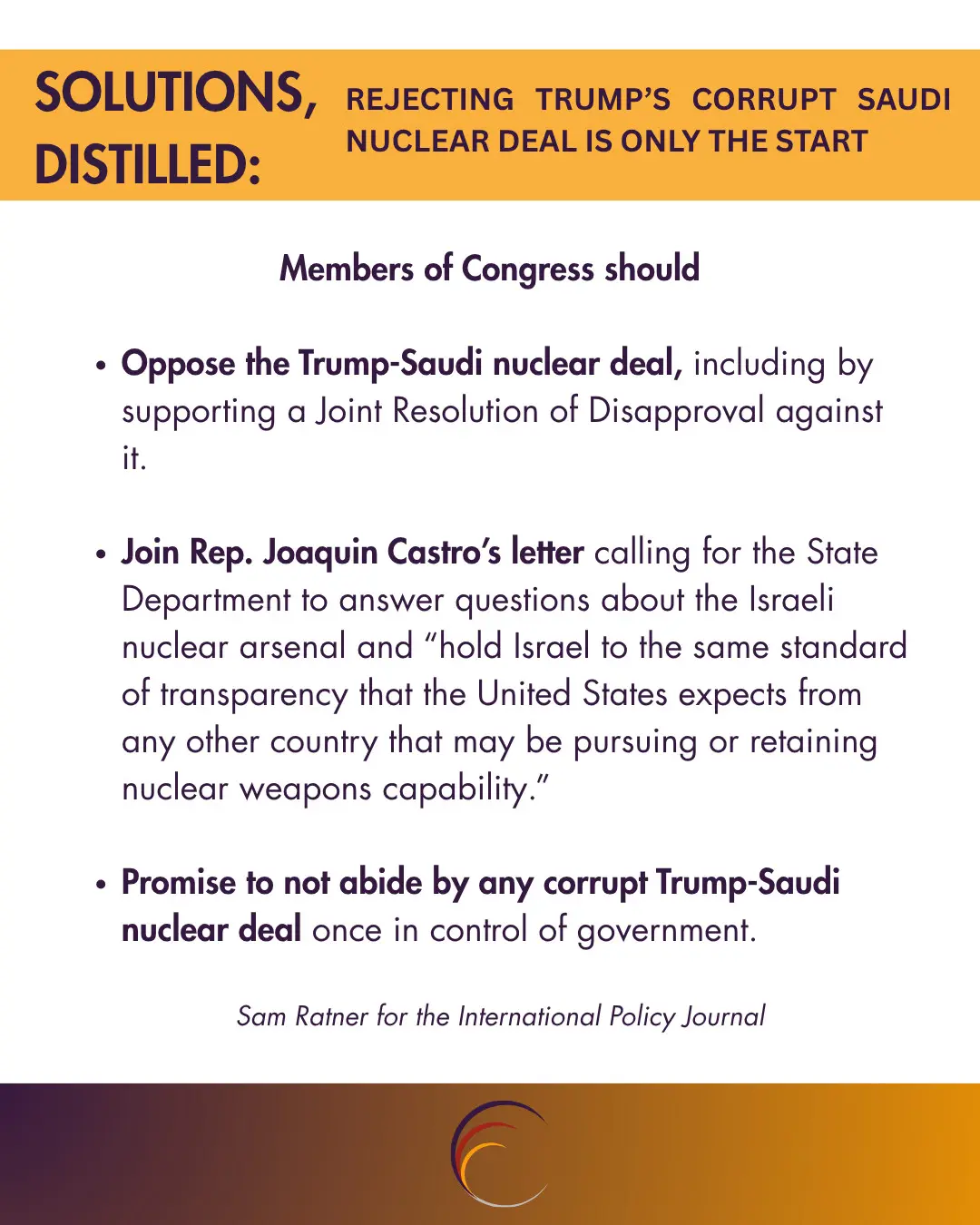
Opposing the deal should be a no-brainer for members of Congress. It creates a massive proliferation risk, upending decades of carefully constructed best practices aimed at preventing nuclear proliferation, and instead commits the United States to bringing Saudi Crown Prince Mohammed bin Salman right to the edge of building a nuclear bomb. It is corrupt, with early reporting indicating that nuclear investments fostered by the deal will enrich Trump himself, his sons, his son-in-law Jared Kushner, and, for good measure, Peter Thiel. Finally, it sets a precedent that other governments in the region, from UAE to Turkey, will be eager to follow as their own incentives to join the arms race grow. A Joint Resolution of Disapproval against the deal has already been introduced in the House, and members should seize this opportunity to stop Trump’s corrupt, disastrous dealmaking dead in its tracks.
Even if Congress does its job and kills the deal, however, the underlying regional challenge will remain. Progressives thus have an opportunity to offer a real alternative to the arms race Trump is spurring by laying out a vision for real, region-wide denuclearization.
Prioritizing denuclearization in the Middle East provides a guiding principle for U.S. diplomacy that is responsive to regional realities, global non-proliferation goals, and the need to move beyond failed paradigms of counterterrorism, fossil fuel extraction, and Israeli government hegemony as the sources of U.S. policy. It allows us to confront the growing arms race head-on, rather than continuing to stumble into an intractable situation where we claim to oppose nuclear proliferation while both incentivizing and actively aiding proliferation threats across the region. Denuclearization offers a goal of peace and stability that other influential powers are already seeking.
Moreover, regional denuclearization is a vision that will be welcome in many quarters, particularly following decades of disastrous U.S. interventions in the Middle East and the ongoing deterioration of the global non-proliferation regime. At a time when the sincerity of Washington’s commitment to nuclear disarmament under the Treaty on the Non-Proliferation of Nuclear Weapons (NPT) is more doubtful than ever, taking real steps toward regional denuclearization would be welcome news for an arms control community reeling from the demise of U.S.-Russian bilateral arms control. For progressives in particular, it can serve as a showcase of the kind of thinking that is possible when we break free of the failed orthodoxies of U.S. policy and place questions of safety and human flourishing at the center of our foreign policy.
Reaching a nuclear-free Middle East requires the U.S. government to finally acknowledge a truth that we have long refused to formally acknowledge: that there is already a rogue nuclear state in the region. Feigned ignorance of the Israeli government’s nuclear arsenal is a dangerous farce which has gone on far too long. Denuclearizing the Middle East will require the Israeli government eventually giving up nuclear weapons, an impossible goal so long as the Israeli government’s chief sponsors in Washington refuse to admit that Israeli nukes even exist.
In the long run, the Israeli government should pursue a path similar to that of the South African government in giving up its nuclear arsenal – publicly acknowledge its weapons, renounce their use, and work with the IAEA to develop a plan to dismantle its nuclear arsenal and join the Treaty on the Non-Proliferation of Nuclear Weapons. In the short run, even individual members of Congress can take important steps toward de-exceptionalizing Israeli nuclear weapons. We’ve already seen positive steps in this direction, including a letter led by Rep. Joaquin Castro and signed by 29 other Democrats calling for the State Department to answer questions about the Israeli nuclear arsenal and “hold Israel to the same standard of transparency that the United States expects from any other country that may be pursuing or retaining nuclear weapons capability.”
Members can also play a key role in the second step toward a regional denuclearization policy – rejecting the U.S.-Saudi nuclear deal explicitly because it is a proliferation risk. The goal of the deal is to lock future U.S. administrations into abetting Saudi nuclear ambitions, but the Trump administration will not last forever, and governments in the region need to hear that the leaders likely to succeed him view any expansion of nuclear weapons in the region as a major source of insecurity. Rejecting this deal or, failing that, making clear that progressives do not intend to abide by it if in power, can cut at least the U.S. role in powering this arms race off at the knees.
In his war on Iran and his Saudi nuclear deal, Trump is offering the worst of America’s violent, corrupt, self-defeating Middle East policy. Progressives should take this opportunity not just to reject his approach, but to offer a real alternative.
By Sam Ratner, policy director at Win Without War.

